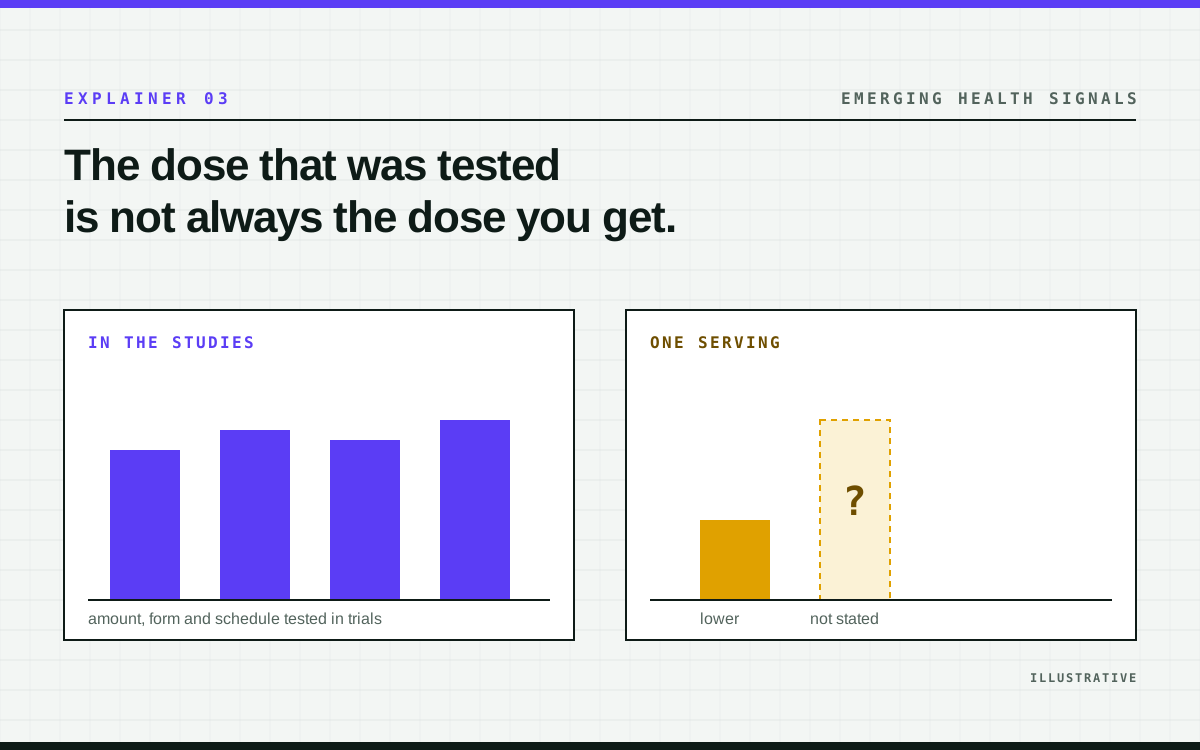
A study never tests "an ingredient." It tests a particular amount of a particular form, taken on a particular schedule, for a particular length of time, in particular people. A product label, meanwhile, picks its own serving for its own reasons: taste, capsule size, cost, the number of servings in a container. When the two line up, the research tells you something about the product. When they do not, the research may be about something else, even if the ingredient name is the same.
The four things a study actually tests
Before comparing anything, write down four variables from the research.
- Amount. Grams or milligrams per day, and whether that was split into portions. Watch for doses expressed per kilogram of body mass, which change with the person.
- Form. The exact compound or preparation: a specific salt, a juice versus a concentrate versus a dried powder, a standardized extract versus a whole food.
- Timing and schedule. Once before an event, daily with meals, at bedtime, with a loading phase first.
- Duration. Three nights, one week, twelve weeks. An effect seen after a week says little about a year, and vice versa.
The NIH Office of Dietary Supplements (ODS) makes a related point from the consumer side: the Supplement Facts label lists the amount per serving, and the manufacturer suggests the serving size, but a health care provider might decide a different amount is more appropriate for you [1].
The comparison is always "study amount of this form, on this schedule, for this long" versus "label amount of this form per serving." If any of the four do not match, the research applies less directly, however familiar the ingredient name.
Four worked comparisons
These examples come from research we cite on our ingredient entries. They show the four most common situations: a close match, a missing number, a form mismatch, and a narrow finding.
Creatine: a protocol a plain powder can match
ODS describes a typical creatine protocol as a loading phase of 20 g a day of creatine monohydrate for 5 to 7 days, taken as four portions of 5 g, followed by a maintenance phase of 3 to 5 g a day; an alternative skips loading and uses about 3 to 6 g a day for 3 to 4 weeks [2]. ODS also notes that monohydrate is the most widely used and studied form [2]. That makes creatine an unusually clean comparison: the form in the research is the form sold in plain tubs, and the daily amount is a scoop a label can state in grams. What remains to check is the serving on the specific label and whether it is monohydrate. Our creatine entry does that for one product.
Beet root: the active amount is often missing
For beets, the relevant compound in the research is dietary nitrate. ODS reports that most studies used about 500 ml of beetroot juice a day, supplying roughly 5 to 11 mmol (310 to 682 mg) of nitrate depending on the product, and that studies have not assessed whether beetroot powders are viable alternatives to the juice or concentrate [2]. A powder label that lists grams of beet root but not milligrams of nitrate leaves the key comparison blank. Our beet root powder entry looks at what one label states.
Tart cherry: one name, several forms
"Tart cherry" in the research covers at least four different things. One randomized crossover trial gave 14 male college students 12 fl oz of a tart cherry juice blend twice a day for eight days [3]. A study of 20 recreational marathon runners used tart cherry juice for five days before the race, on race day and for 48 hours after [4]; ODS describes that study's amount as 472 ml a day [2]. A trial in 10 well-trained men used a juice concentrate for seven days before and 48 hours after a bout of leg exercise [5]. ODS also describes a study of a supplement containing 480 mg of freeze-dried tart cherry skin powder [2]. These are not interchangeable, and results from one do not automatically carry over to a bottle of ready-to-drink juice. Our tart cherry entry sets one bottle beside the studies that most resemble it.
Glycine: a narrow finding at a specific amount
A 2012 study in Frontiers in Neurology gave healthy volunteers 3 g of glycine or a placebo before bedtime for three nights during which their sleep was restricted to 25% less than usual, and measured next-day sleepiness, fatigue and performance on a computer task [6]. The dose to compare is 3 g at bedtime, and the outcome is how people felt and performed after short sleep, which is not quite the same thing as how well they slept. Our glycine entry compares a label serving with that amount.
What the research shows
What the hype says
- Ingredient names are often used as if any amount or format carried the same research.
- Serving sizes are rarely compared with study amounts in product talk.
- A finding in one group, such as trained athletes, is often presented as general advice.
Hype is described in our words, not quoted, and is not a claim by this site.
How to find the study dose, and set it beside a label
You rarely need the full paper. Work through these steps with the abstract open in one tab and the label in the other.
Open the abstract on PubMed
Search the study title or PMID. The methods section of the abstract usually states the amount, form, schedule and duration in one or two sentences. If it does not, the full text (often free through PubMed Central) will, in the methods section.
Note the form precisely
Copy the exact wording: "creatine monohydrate," "juice concentrate," "freeze-dried skin powder." Then look for that same wording on the label.
Read the label's serving size correctly
Under FDA rules, one serving of a dietary supplement is the maximum amount recommended on the label for one eating occasion; if directions say 1 to 3 tablets with breakfast, the serving size is 3 tablets [7]. The amounts in the Supplement Facts panel are per that serving.
Convert to the same units and the same day
If a study used 20 g a day in four portions, compare daily totals, not single scoops. If a study dosed by an active compound (such as nitrate), you need that compound's amount on the label; the weight of the whole ingredient is not a substitute.
Write a one-line verdict
Matches, lower, higher, or not stated on the label. That single line, which we print on every ingredient entry, is often more informative than any claim on the package.
When more is not better: upper limits
A label dose that is higher than the study dose is not automatically an advantage. For some nutrients there is a Tolerable Upper Intake Level (UL), which ODS defines as the maximum daily intake unlikely to cause adverse health effects [8]. Magnesium is a clear example. ODS lists Recommended Dietary Allowances of 400 to 420 mg a day for adult men and 310 to 320 mg for adult women (higher in pregnancy), but a UL of 350 mg a day for magnesium from supplements and medications in everyone age 9 and older. The UL sits below the RDA because it counts only supplements and medications, not magnesium from food and drinks [8]. The Daily Value used on labels is 420 mg [8], which means a supplement serving at 100% of the Daily Value would exceed the supplemental upper limit. ODS also reports that 48% of Americans get less magnesium from food and beverages than their Estimated Average Requirement [8], which is a reason to look at diet first and total intake second. Our magnesium entry puts one product's serving in that context, and our explainer on checking a supplement label covers % Daily Value in more detail.
Labels can also run the other way. FDA requires that an added dietary ingredient be present at 100% of the declared amount, and a naturally occurring one at no less than 80% [7], but those rules concern what is declared, not whether the declared amount matches any study.
A dose that was well tolerated in a study of healthy volunteers may not suit you. Kidney function, pregnancy, other supplements and prescription medicines can all change what is appropriate, and magnesium in particular interacts with several drug classes, including some antibiotics [8]. Check with a clinician or pharmacist before changing how much you take.
Sources
- NIH Office of Dietary Supplements. Dietary Supplements: What You Need to Know, Fact Sheet for Consumers, updated January 4, 2023. ods.od.nih.gov
- NIH Office of Dietary Supplements. Dietary Supplements for Exercise and Athletic Performance, Fact Sheet for Health Professionals (creatine, beetroot and tart cherry sections), updated April 1, 2024. ods.od.nih.gov
- Randomized, placebo-controlled crossover trial of a tart cherry juice blend (12 fl oz twice daily for eight days) in 14 male college students performing eccentric elbow exercise. British Journal of Sports Medicine, 2006. PMID 16790484. pubmed.ncbi.nlm.nih.gov
- Trial of tart cherry juice versus placebo in 20 recreational marathon runners, taken for five days before, on the day of and for 48 hours after the race. Scandinavian Journal of Medicine & Science in Sports, 2010. PMID 19883392. pubmed.ncbi.nlm.nih.gov
- Crossover trial of a Montmorency cherry juice concentrate versus a fruit concentrate in 10 well-trained men after intensive single-leg exercise. Medicine & Science in Sports & Exercise, 2011. PMID 21233776. pubmed.ncbi.nlm.nih.gov
- Study of 3 g glycine or placebo before bedtime in healthy volunteers during three nights of restricted sleep, measuring next-day sleepiness, fatigue and task performance. Frontiers in Neurology, 2012. PMID 22529837. pubmed.ncbi.nlm.nih.gov
- U.S. Food and Drug Administration. Dietary Supplement Labeling Guide, Chapter IV: Nutrition Labeling (serving size, declared amounts, proprietary blends). fda.gov
- NIH Office of Dietary Supplements. Magnesium, Fact Sheet for Health Professionals (RDAs, upper limits, Daily Value, U.S. intakes, medication interactions), updated January 6, 2026. ods.od.nih.gov
This explainer is educational and is not medical advice. Ask a qualified clinician or pharmacist before starting any supplement, especially if you have an existing condition or take medication.