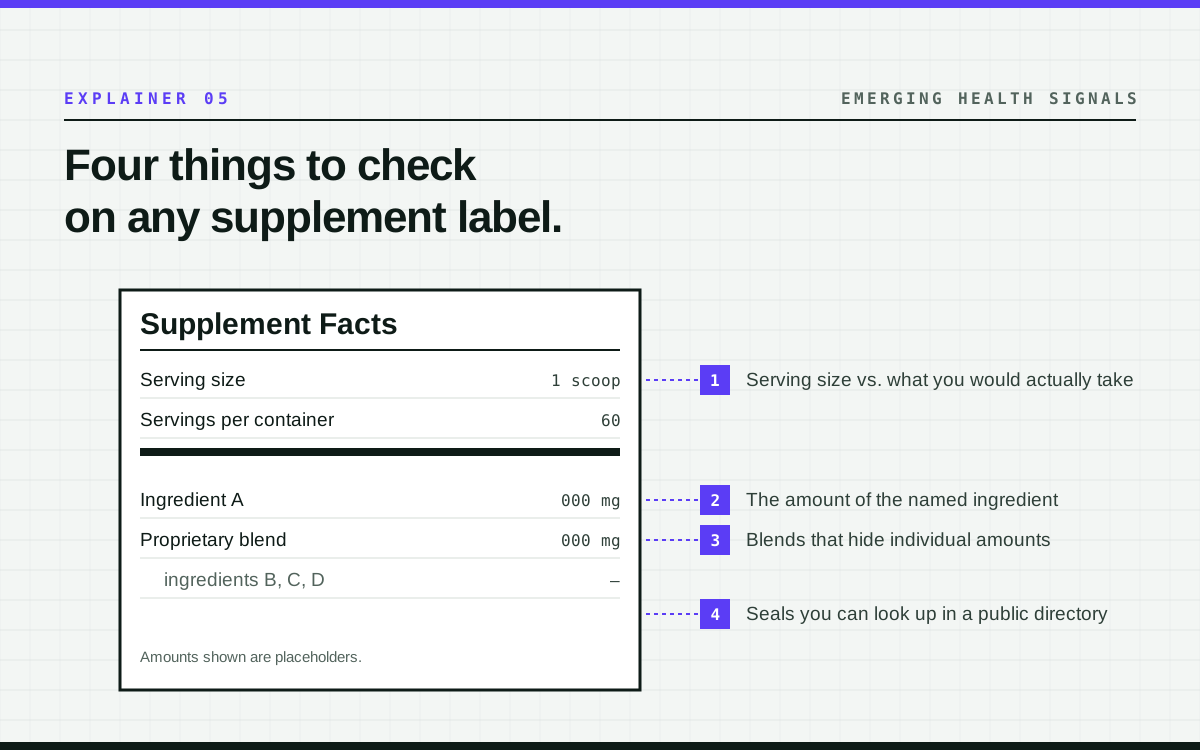
A supplement label is the one piece of product information that federal rules shape in detail, which makes it the most reliable thing on the package and the best place to start. It will not tell you whether a product works; FDA is not authorized to approve dietary supplements for safety and effectiveness before they are marketed [1]. But read line by line, it tells you exactly what you would be taking, in what amount, and sometimes what it leaves unsaid.
What every label must carry
FDA's Dietary Supplement Labeling Guide organizes the required information into five statements: a statement of identity (the name of the product, including the words "dietary supplement" or a descriptive equivalent), the net quantity of contents, nutrition labeling in the form of a Supplement Facts panel, an ingredient list, and the name and place of business of the manufacturer, packer or distributor [2] [14]. Anything else on the package, from a front-of-pack slogan to a structure/function statement, is marketing that must follow separate rules.
Those structure/function statements are the lines that describe how an ingredient relates to a body function. FDA does not pre-approve them; the company must have substantiation, notify FDA within 30 days of marketing, and print a disclaimer that FDA has not evaluated the statement and that the product is not intended for any disease use [3]. When you see that disclaimer, it tells you the sentence above it is the seller's own.
The Supplement Facts panel and ingredient list are the regulated core. Front-of-pack wording and claims are the seller's description. Read the panel first and the slogans last.
The Supplement Facts panel, line by line
Work down the panel in this order.
Serving size and servings per container
Under FDA rules, one serving equals the maximum amount the label recommends for one eating occasion; if directions say 1 to 3 tablets with breakfast, the serving size is 3 tablets [4]. Every amount below refers to that serving. Compare it with what you would actually take, and divide the price by servings per container to get a cost per serving.
The amount per serving of each dietary ingredient
Look for the exact form (for example, a named mineral compound rather than just the mineral) and the amount in grams or milligrams. FDA requires an added dietary ingredient to be present at 100% of the declared amount, allowing for analytical variation, and a naturally occurring one at no less than 80% [4]. Then compare that amount with the amount used in the research; our explainer on study dose versus label dose shows how.
% Daily Value, and the footnote symbol
Ingredients that have a Daily Value show a percentage. Ingredients without one carry a symbol pointing to the footnote "Daily Value not established" [4]. That footnote is not a warning or a quality signal; it just means there is no reference amount to compare against.
Proprietary blends
A blend may be listed under the term "Proprietary Blend" or a fanciful name. FDA requires the total weight of the blend on the same line and the ingredients indented below in descending order by weight, but not the amount of each one [4]. The practical consequence: you can see which ingredient is most plentiful, but you usually cannot tell whether any of them is present at an amount used in research.
Other ingredients
Below the panel, the ingredient list names the rest of the product. ODS describes these as fillers, binders, flavorings and similar components [5]. Check this list for allergens, sweeteners and anything you prefer to avoid.
% Daily Value is not a safety ceiling
A high percentage can look like good value, but % Daily Value and safe upper limits are different measures. Magnesium shows the gap clearly. The NIH Office of Dietary Supplements (ODS) gives the Daily Value used on labels as 420 mg, while the Tolerable Upper Intake Level for magnesium from supplements and medications is 350 mg a day for everyone age 9 and older [6]. A serving labeled 100% of the Daily Value would therefore be above the supplemental upper limit. ODS explains that the upper limit is lower than the recommended intake because it counts only supplements and medications, not magnesium in food [6].
ODS also cautions that because vitamins and minerals are added to many foods and drinks, you may get more than you think, and that more is not necessarily better [5]. If you take several products, add up the same nutrient across all of them. Our magnesium entry works through one product's serving with these numbers.
What the quality seals mean
Several independent organizations test supplements and let products that pass display a seal. ODS summarizes what such a seal indicates: that the product was properly manufactured, contains the ingredients listed on the label, and does not contain harmful levels of contaminants. It adds that these seals do not guarantee that a product is safe or effective [5]. The programs differ in detail, and the names are easy to conflate, so read each one on its own terms.
- USP Verified. A verification program run by U.S. Pharmacopeia, one of the organizations ODS lists as offering quality testing [5]. Confirm a product in USP's own records before crediting the mark.
- NSF certification for dietary supplements (NSF/ANSI 173, often shown as "Contents Certified"). NSF describes three parts: a label claim review to confirm what is on the label is in the bottle, a toxicology review of intentionally added ingredients, and a contaminant review for undeclared ingredients or unacceptable levels of contaminants, with annual audits and periodic retesting [7]. NSF's public listing can be searched by product or company [8].
- NSF Certified for Sport. A separate program built on top of the NSF/ANSI 173 certification for products aimed at athletes; NSF says it also screens for 280 substances banned by most major athletic organizations [7]. It has its own product search, which accepts a lot number [9]. A product can hold the base NSF certification without Certified for Sport.
- Informed Choice and Informed Sport. Programs run by LGC Group. LGC describes Informed Choice as monthly retail-monitoring tests for banned substances plus oversight of manufacturing, and Informed Sport as testing of every batch of a product before release [10]. The Informed Choice site lets you search certified products by brand, product name or batch number [11].
Two phrases look like seals and are not. "Made in a GMP facility" describes a legal requirement: FDA's current good manufacturing practice rule for dietary supplements (21 CFR Part 111) applies to anyone who manufactures, packages, labels or holds a dietary supplement sold in the U.S. [12], and FDA periodically inspects these facilities [5]. "Third-party tested," without the name of a program you can look up, cannot be checked. NCCIH makes a related point: a manufacturer's use of words such as "standardized," "verified" or "certified" does not necessarily guarantee quality or consistency [13].
What the research shows
What the hype says
- Packaging often uses words like "certified" or "tested" without naming a program.
- High % Daily Value figures are often presented as a selling point.
- Seals are sometimes presented as if they said something about results.
Hype is described in our words, not quoted, and is not a claim by this site.
A before-you-buy checklist
These are the same checks we run for the fact sheet on each ingredient entry.
- Is the serving size what you would actually take, and what does one serving cost?
- Is each active ingredient listed with its exact form and amount, or hidden inside a blend?
- Does that amount match the amount used in research on the use you care about?
- Is any nutrient near or above its upper limit once you add your other products?
- Does the label name a specific seal, and does the product appear in that certifier's own listing?
- Is the "Other ingredients" list compatible with your allergies and preferences?
- Does the front of the pack say more than the panel can support?
A clean label and a genuine seal still do not make a product right for you. Supplements can interact with medicines and matter around surgery and pregnancy; ODS gives the example that vitamin K can reduce the effect of the blood thinner warfarin [5]. Keep a list of everything you take and review it with a clinician or pharmacist.
Sources
- U.S. Food and Drug Administration. Information for Consumers on Using Dietary Supplements. fda.gov
- U.S. Food and Drug Administration. Dietary Supplement Labeling Guide (April 2005), Chapter I: General Dietary Supplement Labeling (the five required label statements). fda.gov
- U.S. Food and Drug Administration. Structure/Function Claims. fda.gov
- U.S. Food and Drug Administration. Dietary Supplement Labeling Guide, Chapter IV: Nutrition Labeling (serving size, declared amounts, Daily Value footnote, proprietary blends). fda.gov
- NIH Office of Dietary Supplements. Dietary Supplements: What You Need to Know, Fact Sheet for Consumers, updated January 4, 2023. ods.od.nih.gov
- NIH Office of Dietary Supplements. Magnesium, Fact Sheet for Health Professionals, updated January 6, 2026. ods.od.nih.gov
- NSF. Dietary Supplement and Vitamin Certification (NSF/ANSI 173 program components and Certified for Sport). nsf.org
- NSF. Listings: NSF Certified Dietary Supplements (searchable directory). info.nsf.org
- NSF. NSF Certified for Sport (program site and certified-product search). nsfsport.com
- LGC Group. INFORMED: overview of Informed Sport and Informed Choice programs. wetestyoutrust.com
- LGC Group. Informed Choice: certified dietary supplements and product search. choice.wetestyoutrust.com
- Electronic Code of Federal Regulations. 21 CFR Part 111, Current Good Manufacturing Practice in Manufacturing, Packaging, Labeling, or Holding Operations for Dietary Supplements (section 111.1). ecfr.gov
- NCCIH. Using Dietary Supplements Wisely. National Institutes of Health. nccih.nih.gov
- U.S. Food and Drug Administration. Dietary Supplement Labeling Guide, Chapter II: Identity Statement. fda.gov
This explainer is educational and is not medical advice. Ask a qualified clinician or pharmacist before starting any supplement, especially if you have an existing condition or take medication.