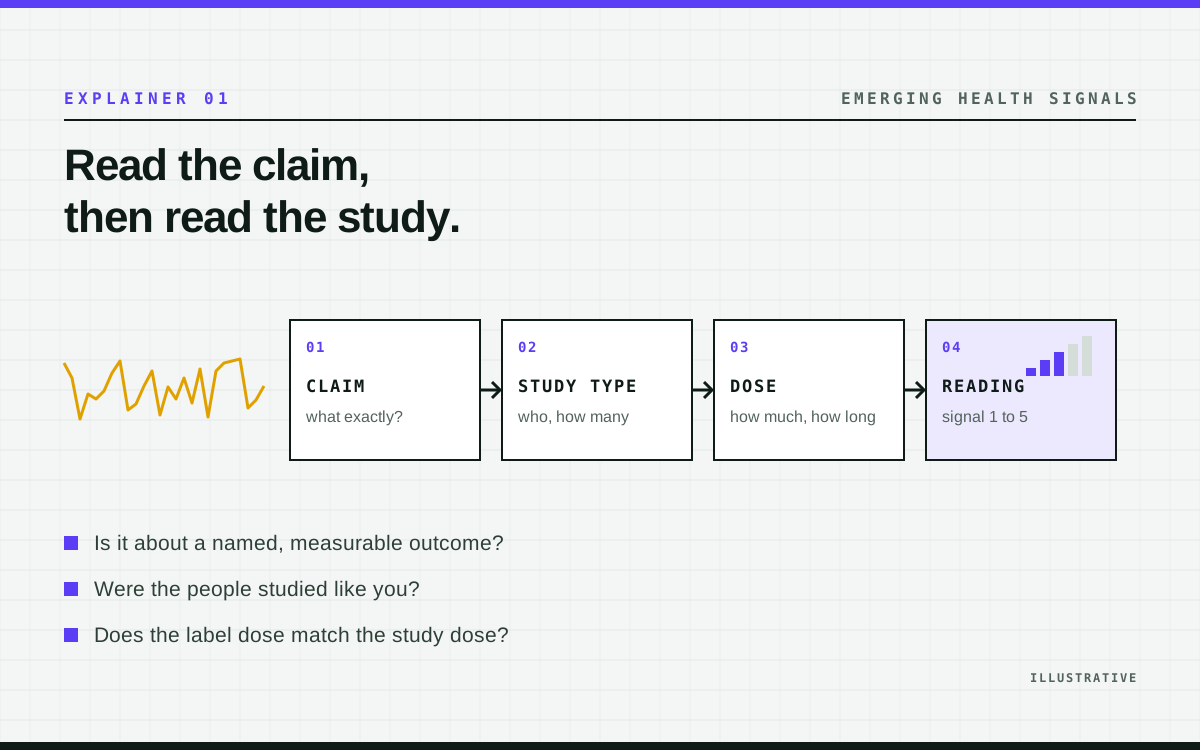
When an ingredient starts trending, the useful question is not "does it work?" but "does it work for what, in whom, at what amount, and according to what kind of evidence?" Those four details decide almost everything, and they are usually the first things to fall away as a finding travels from a journal into a post, a product page or a conversation. This explainer gives you a short routine for putting them back.
The routine is the same one we use to set the reading on every ingredient entry on this site. It does not require a science degree, and it does not require you to trust us: every step points to public sources you can open yourself, starting with the National Center for Complementary and Integrative Health's "Know the Science" materials [1].
Why popularity is not a measurement
Ingredients trend for many reasons: a new product launch, a celebrity routine, a clever video, an interesting lab result, a seasonal habit. Research is only one input, and often not the loudest. Two features of the U.S. market make the gap between attention and evidence especially easy to miss.
First, dietary supplements are not reviewed before they are sold. NCCIH states plainly that the Food and Drug Administration is not authorized to review supplements for safety and effectiveness before they are marketed, and it notes that a label's contents may not always match what is in the product [3]. Second, the claims printed on labels follow their own rules. A "structure/function" statement, such as the FDA's own examples that calcium builds strong bones or that fiber maintains bowel regularity, is not pre-approved by the agency; the company must hold substantiation, notify FDA within 30 days of marketing the product, and print a standard disclaimer saying FDA has not evaluated the statement and that the product is not intended for any disease use [4].
Advertising is policed separately. The Federal Trade Commission's Health Products Compliance Guidance expects health claims to rest on "competent and reliable scientific evidence," says randomized, controlled human trials are generally what experts would require, and warns that research must be relevant to the specific product and the specific advertised benefit [5]. That standard is a good template for readers too: it is, in effect, the checklist below.
A related trap is the word "natural." NCCIH points out that natural does not necessarily mean safer or better: it notes that kava may be associated with severe liver damage, and that FDA banned supplements containing ephedrine alkaloids in 2004 for safety reasons, since ephedra is associated with heart problems [2]. Where an ingredient comes from tells you nothing about how well it has been tested.
A claim is only as specific as its weakest detail. If you cannot name the outcome, the people studied, the study design and the dose, you do not yet know what the claim is, let alone whether it holds up.
The five-step routine
Work through these in order. Each step narrows the claim until it is concrete enough to check.
Pin down the exact claim and outcome
Rewrite what you heard as one sentence with a measurable outcome: "Taking X improves Y, measured as Z." Vague phrases such as "supports wellness" or "helps you feel your best" cannot be tested, so they cannot be confirmed either. If the outcome is a lab value or a marker rather than something a person feels or does, note that too; the explainer on signal vs. noise in health headlines covers why that distinction matters.
Find the study type
Is the claim based on cells in a dish, animals, people observed in daily life, a randomized trial, or a pooled review of several trials? NCCIH describes clinical trials as the studies that give the clearest information about whether an approach is effective and safe in humans, and systematic reviews and meta-analyses as a way of checking whether many studies reach similar conclusions [6]. Our explainer on what a meta-analysis is shows how to read one.
Check who was studied, how many, and for how long
A trial in a dozen trained young athletes over one week is a real result, but a narrow one. NCCIH's checklist for health news asks whether enough people were studied, whether they resemble you in ways that matter such as age or sex, whether the study lasted long enough to show longer-term benefits or risks, and whether this is the first time the result has been reported [7].
Compare the dose and form
Studies test a particular amount, form, schedule and duration. A product may use a different form, a smaller serving, or not state the active compound at all. The FTC guidance makes the same point from the seller's side: research has to match the product being sold [5]. Our explainer on study dose versus label dose walks through this comparison.
Decide how loud the signal is
Only now weigh it. Several agreeing pooled reviews of human trials at a dose a label can match is a strong signal for that one use. A handful of small, short trials is a faint one. Mostly lab, animal or anecdotal evidence is fainter still. Our method sets out the five levels we use, and each ingredient entry explains its own reading with citations.
A worked example: beet root powder and endurance
Beets are a useful test case because the research is real, reasonably well known, and easy to connect to the wrong product. Here is the routine applied to the common idea that beet products help with endurance exercise.
Step 1, the claim. Rewritten precisely: dietary nitrate from beetroot improves performance in endurance exercise, measured in time trials or time-to-exhaustion tests.
Step 2, the study type. The NIH Office of Dietary Supplements (ODS) fact sheet on exercise and athletic performance summarizes clinical trials and a joint position statement from sports nutrition and sports medicine organizations. It describes the clinical trials as limited, with conflicting results [8].
Step 3, who was studied. ODS reports that any benefit appears to be most effective in recreationally active nonathletes, and the trials involved runners, swimmers, rowers and cyclists [8]. That is a specific group doing specific tests.
Step 4, the dose and form. This is where the example becomes instructive. ODS notes that most studies used about 500 ml of beetroot juice a day (about 2 cups), taken once roughly 2.5 to 3 hours before exercise or daily for up to 15 days, supplying about 5 to 11 mmol (310 to 682 mg) of nitrate depending on the product. It then adds that some supplements contain beetroot powder in varying amounts, but studies have not assessed whether these are viable alternatives to the juice or concentrate [8]. So the question for any powder is: does the label state its nitrate content, and how does that compare with 310 to 682 mg?
Step 5, the reading. Our entry on beet root powder weighs exactly these points against one product's label and sets its reading there, with the sources cited.
What the research shows
What the hype says
- Workout content often presents beet products as a general pre-exercise habit for anyone.
- Product talk tends to present any beet format, juice, powder or capsule, as interchangeable.
- The amount of nitrate per serving rarely comes up.
Hype is described in our words, not quoted, and is not a claim by this site.
Quick checks for anything you read
When you do not have time for the full routine, these questions catch most problems.
- Can you name the specific outcome that was measured, in plain words?
- Were people studied, or only cells or animals?
- Is the source a single new study, or a review of many?
- Does the product state the amount and form that was tested?
- Who is telling you, and do they sell the product? NCCIH's checklist asks whether a study was funded by a group that could profit from its findings [7].
- Is the language certain ("always", "for everyone") where the research is hedged?
- Does the claim drift from a body function into a disease? Supplements may not be sold for disease use [4].
Reading research well is not a substitute for individual advice. Supplements can interact with medicines and matter more around surgery, pregnancy and chronic conditions; NCCIH recommends telling your health care providers about any supplement you use [3]. A strong reading for one use says nothing about safety for you.
Sources
- National Center for Complementary and Integrative Health (NCCIH). Know the Science: hub of tools for understanding health research. National Institutes of Health. nccih.nih.gov
- NCCIH. Natural Doesn't Necessarily Mean Safer, or Better. National Institutes of Health. nccih.nih.gov
- NCCIH. Using Dietary Supplements Wisely. National Institutes of Health. nccih.nih.gov
- U.S. Food and Drug Administration. Structure/Function Claims: definition, notification and disclaimer requirements for dietary supplements. fda.gov
- Federal Trade Commission. Health Products Compliance Guidance (replaces the agency's 1998 dietary supplement advertising guide). ftc.gov
- NCCIH. How To Make Sense of a Scientific Journal Article: Methods, Types of Research. National Institutes of Health. nccih.nih.gov
- NCCIH. Checklist for Understanding Health News Stories. National Institutes of Health. nccih.nih.gov
- NIH Office of Dietary Supplements. Dietary Supplements for Exercise and Athletic Performance, Fact Sheet for Health Professionals (beetroot section), updated April 1, 2024. ods.od.nih.gov
This explainer is educational and is not medical advice. Ask a qualified clinician or pharmacist before starting any supplement, especially if you have an existing condition or take medication.